
Good Morning, Friend.
You’ve been on my mind and in my heart.
Lately, I can’t stop thinking about the quiet, often invisible ways we as women speak to ourselves.
The harsh inner dialogue.
The impossible standards.
The constant feeling that somehow, no matter how much we’ve accomplished, we’re still not enough.
As a coach, a sociologist, a mother, a daughter, a sister, a friend—and as a woman myself—I witness this every single day.
It’s breaking my heart.
We walk through our lives believing stories about ourselves that simply aren’t true. We criticize ourselves before anyone else has the chance. We focus on our flaws before we ever notice our strengths. We question our worth while everyone around us sees our brilliance.
My darling friend, these stories are not only unkind—they’re categorically false.
So, where do they come from?
The answer begins with something psychologists call the “negativity bias”—our brain’s natural tendency to notice what’s wrong before it notices what’s right. It’s one of the ways our nervous system has evolved to keep us safe.
And that brings us to what may be my favorite “nerdy deep dive” of all time.
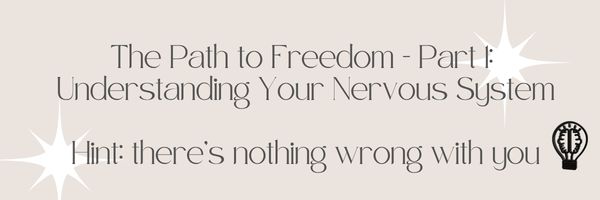
Because once you understand your nervous system, you begin to understand yourself.
Not as broken.
Not as weak.
Not as “too much” or “not enough.”
But as a beautifully adaptive human being whose biology has been trying to protect her all along.
Over the next four weeks…
I’m inviting you into a conversation that sits at the very heart of my coaching work.
Together we’ll explore:
- Why we people-please.
- Why perfectionism feels impossible to escape.
- Why we overthink and second-guess ourselves.
- Why setting boundaries can feel terrifying.
- Why we stay stuck, even when we desperately want change.
And perhaps most importantly…
We’ll discover why none of those things mean there is something wrong with you.
Because they aren’t character flaws. They’re survival strategies.
Your nervous system has one job.
Despite what our culture often tells us, your nervous system isn’t designed to make you happy.
It’s designed to keep you alive.
For thousands of years, survival depended on belonging to a tribe. Being rejected didn’t simply hurt your feelings—it threatened your survival.
Your biology remembers that.
While we are no longer outrunning saber-toothed tigers, our nervous systems haven’t fully caught up with modern life. Today, they often react to emotional and social threats as though they’re physical danger.
- A critical comment.
- Conflict.
- Rejection.
- Feeling left out.
- Disapproval.
- Shame.
- Not belonging.
To your nervous system, these can all register as threats. Its response isn’t logical. It’s protective.
Because, remember, its job is to keep you safe, and it does that by choosing what’s familiar and predictable—even when what’s familiar isn’t healthy.
That’s why we often hear the saying:
“Your nervous system will choose a familiar hell over an unfamiliar heaven.”
It’s a sobering thought but it explains so much.
Why we stay stuck.
Have you ever wondered why you don’t speak up in the meeting?
Why you stay in relationships that no longer serve you?
Why you apologize for taking up space?
Why you clock your “flaws” in the dressing room?
Why you hesitate to chase the dream that’s been quietly calling your name?
Why you’re so much kinder to everyone else than you are to yourself?
These aren’t random behaviors.
They’re often your nervous system trying to preserve what it believes is safety.
Because for your nervous system, certainty feels safer than possibility.
Belonging feels safer than authenticity.
Predictability feels safer than growth.
Even when those choices leave you feeling anxious, resentful, lonely, exhausted, or disconnected from yourself.
The real source of our suffering.
After years of studying sociology, psychology, and human behavior—and years of walking alongside incredible women as their coach—I’ve come to believe that much of our suffering lives in one place:
The gap between who we truly are…
…and who we’ve learned we need to become in order to belong.
That gap is exhausting.
It’s where perfectionism lives.
It’s where people-pleasing grows.
It’s where anxiety, burnout, loneliness, and self-doubt quietly take root.
For me, it was where striving was the norm
The beautiful irony?
Everything your soul longs for—peace, confidence, joy, freedom, authenticity, connection—often lives on the other side of the very fears your nervous system is trying to protect you from.
Which is why understanding your nervous system isn’t just interesting.
It’s liberating.
So let me leave you with this.
There is nothing wrong with you.
Read that again.
There is nothing wrong with you.
You are not failing. You are not broken. You are not too much. You are NOT not enough.
You are a beautifully adaptive woman living in a culture that asks an extraordinary amount of women.
Your nervous system has simply been doing exactly what it was designed to do.
Instead of asking,
“What’s wrong with me?”
What if you began asking,
“What has my nervous system been trying to protect?”
That single question can begin to change everything.
Next week…
We’ll explore the specific survival strategies women most commonly develop—people-pleasing, perfectionism, overthinking, self-abandonment, and more—and why they make so much sense once you understand the nervous system.
Until then, sweet friend,
Be gentle with yourself.
Notice the stories your mind tells you.
And when you hear that familiar inner critic whispering that you’re not enough, telling you to stay quiet or compliant or urging you to work yourself to the bone, simply remind yourself:
“Perhaps this isn’t the truth. Perhaps this is survival.”
With so much love,
Jill ♥️
|
|
|
|
|